 中文版
中文版




releaseTime:2025-11-21 13:58:00source:Mu TiannumberOfPageViews:0
The lifting capacity and rotation radius (or working range) of a mobile manual hoist (usually referring to a movable chain hoist or hand cranked hoist) need to be determined according to the specific type and design. The following is a detailed explanation:
1、 Range of lifting capacity
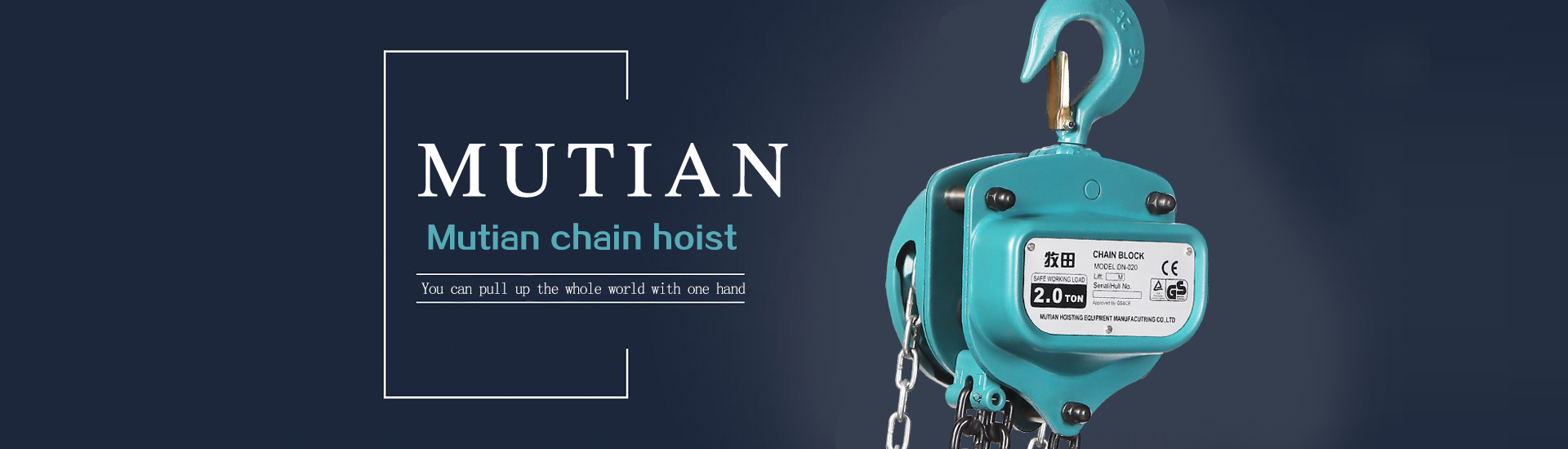
chain hoist
Lifting capacity: Generally ranging from 0.5 tons to 30 tons, some special models can reach up to 50 tons or even 100 tons.
Features: By manually pulling the hand zipper strip to drive the sprocket and gear, the lifting chain is driven to lift and lower heavy objects. Built in ratchet and pawl prevent heavy objects from falling freely, suitable for short distance and vertical lifting.
Applicable scenarios: factories, warehouses, construction sites, etc., can be used alone or as a lifting mechanism for beam cranes and overhead monorail systems.
Lever Hoist
Lifting capacity:
Ring chain: generally not exceeding 3 tons.
Wire rope type: The traction or lifting capacity is usually below 3 tons, supporting diagonal and horizontal traction.
Features:
Ring chain: By pulling the handle to drive the transmission mechanism, the chain is operated directly on the ground.
Wire rope type: By alternately clamping the wire rope with clamps, it can move and pull heavy objects in both directions.
Applicable scenarios: occasions that require horizontal or diagonal traction, such as equipment installation, pipeline laying, etc.
2、 Rotation radius (working range)
chain hoist
Rotation radius: usually refers to the vertical lifting range of the lifting chain, with a lifting height generally ranging from 2.5 meters to 3 meters, and some models can be customized to be higher (such as 30 meters).
Horizontal movement: If a heavy object needs to be moved horizontally, it needs to be used in conjunction with a monorail trolley or cantilever crane, and the working range is determined by the length of the track or cantilever.
Lever Hoist
Rotation radius:
Loop chain: The lifting height is usually 1.5 meters, and the horizontal traction distance depends on the length of the steel wire rope or chain.
Wire rope type: Continuous movement is achieved by alternately clamping the wire rope, making the working range more flexible, but requiring reserved operating space.
Diagonal traction: Some models support diagonal traction, and the angle needs to be determined according to the equipment specifications (such as a maximum tilt angle of 30 °).
3、 Choose Suggestions
According to load requirements:
Light duty operation (≤ 3 tons): Priority should be given to using chain hoists or loop type hand cranked hoists, which are low-cost and easy to operate.
Heavy duty operations (>3 tons): High tonnage chain hoists or professional lifting equipment (such as electric hoists) should be selected.
Horizontal/diagonal traction: Choose a wire rope type hand cranked hoist, pay attention to the traction angle and rope length.
According to space limitations:
Limited vertical space: Choose a model with customizable lifting height (such as a chain hoist with a maximum lifting capacity of 30 meters).
Limited horizontal space: Use a compact hand-operated hoist or a monorail trolley to reduce the occupied area.
Safety precautions:
Overloading is strictly prohibited. Hand pulled hoists weighing over 5 tons must be operated by multiple people in coordination.
Keep the chain vertical during operation to avoid chain jamming or breakage caused by diagonal pulling.
Regularly check the wear of the braking device and chain to ensure safety and reliability.
The main equipment produced by Hebei Makita: stage electric hoist, electric chian hoist, wire rope electric hoist,Hand chain hoist, lever hoist, pneumatic hoist and other lifting equipment
 phone
phone
 service
 message
 e-mail
