 中文版
中文版





releaseTime:2025-10-16 09:09:52source:Mu TiannumberOfPageViews:0
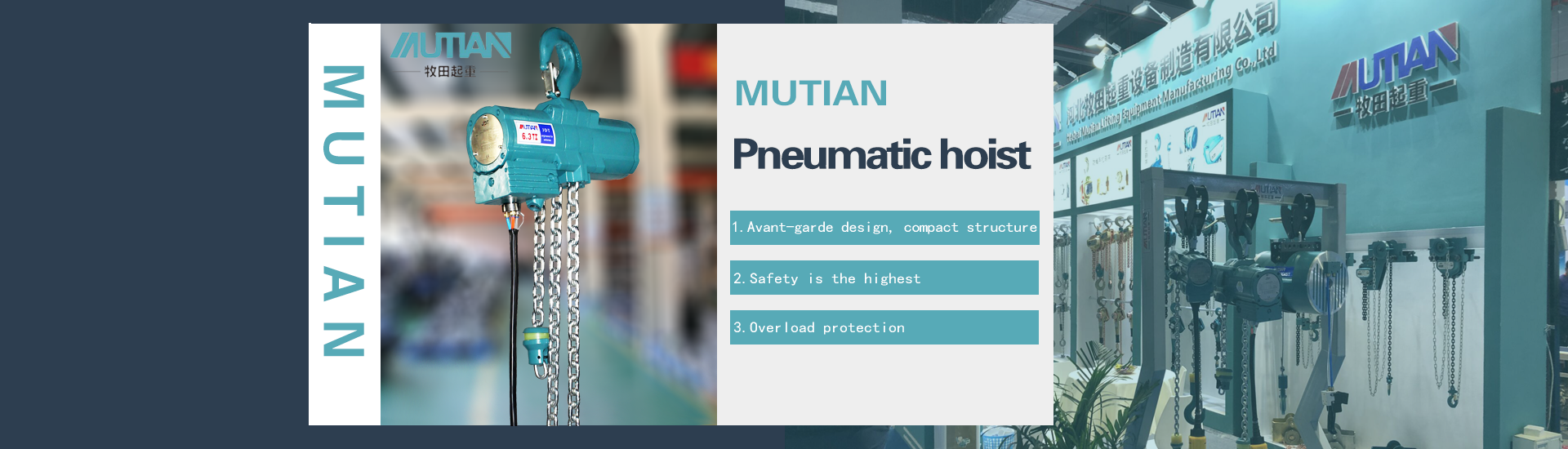
During the operation of pneumatic hoists, targeted preventive measures should be taken at different stages of use, including installation and commissioning, daily operation, maintenance, and special environmental applications. The following are specific precautions and analysis:
1、 Installation and commissioning phase
Basic stability
Choose a flat and solid installation ground to avoid equipment tilting due to ground subsidence. The suspension structure needs to be reinforced with anchor cables, such as at least 2 anchor cables for a 6-ton pneumatic hoist, 4 for a 10 ton equipment, and 6 for a 20 ton equipment, to ensure that the bearing capacity meets 1.5 times the rated load.
Quality control of gas source
Compressed air must meet the requirements of cleanliness (particle size<40 μ m, concentration<5g/m ³) and dryness. Configure a three-level filtration system (with an accuracy of 5 μ m), and the diameter of the inlet pipe should be one specification larger than the outlet pipe (such as DN20 inlet pipe). Regularly blow the pipe with air pressure and clean the filtration device once a month.
No load trial operation
After installation, a 30 minute no-load test is required to check the response of the up/down button, the function of the guide rail safety accessories (such as limit switches), and the braking sliding amount (S ≤ V/100 under rated load, V is the stable lifting distance under load for 1 minute).
2、 Daily operation stage
Load management
Overloading is strictly prohibited: Double protection is provided through a force limiter (set value ≤ 110% of rated load) and an overload protection clutch. It is forbidden to use the clutch to measure the load.
Load stability: Before lifting, confirm the load balance and avoid diagonal pulling (adjust the lifting point position when the angle is greater than 5 °). The tip of the hook should not be hooked, and the load chain should be fixed on the pulley.
Space control: When the operator is walking, the height of the load above the ground should be ≤ 80cm (≤ 3m when encountering obstacles). It is strictly prohibited to cross over personnel's heads. During lifting, except for the operator, other personnel must maintain a safe distance of at least 5 meters.
Operating Specifications
Start/Stop Principle: Follow the principle of "slow start, slow stop" to avoid equipment impact caused by emergency stop and start.
Hook operation: Ensure that the hook is aligned with the control direction and avoid swinging (pause adjustment is required when the horizontal swing amplitude is greater than 50mm).
Unattended prohibition: During operation, do not leave the equipment. When pausing, lower the load to the ground and do not park in the air.
emergency response
Fault response: When abnormal sound, vibration, or brake failure is detected, immediately cut off the air source and lower the load to an unmanned area.
Gas cut-off protection: When the wind pressure exceeds the limit (such as>0.8MPa), the protection device will be automatically triggered. Before removing the gas pipe, the gas source valve must be closed.
3、 Maintenance phase
regular inspection
Daily inspection items: flexibility of control switch, integrity of secondary protection steel cable, effectiveness of hook anti detachment device.
Weekly inspection items: brake sliding amount, limit switch function, load chain wear (replace when the thickness is reduced to 70% of the original value).
Monthly inspection items: cleanliness of air source filtration device, anchoring status, motor overheating protection function (may be triggered after continuous operation of 10-20 ton equipment).
Lubrication management
Lubrication cycle: Add ISO VG32 pneumatic tool oil (motor) and molybdenum disulfide grease (gear train) every 200 hours.
Lubrication method: Use a hard bristled brush or small wooden pieces to apply oil, and it is strictly prohibited to directly touch the moving parts with hands.
Replacement of spare parts
List of vulnerable parts: Load chain (replace immediately when bent/twisted), O-ring (replace every 800 hours), brake pads (replace when thickness<1.5mm).
Spare parts management: Adopting the ABC classification method, the inventory of Class A spare parts (such as motor blades) is ≥ 3 sets, and the inventory of Class B spare parts (such as gears) is ≥ 2 sets.
4、 Special Environment Application Stage
high-temperature environment
When used in an environment above 60 ℃, it is necessary to install insulation boards (temperature resistance ≥ 200 ℃) on the gourd shell and shorten the lubrication cycle to every 100 hours.
Corrosive environment
Chemical facilities require the use of 316L stainless steel chains, which should be cleaned every 500 hours and coated with anti rust grease (such as MoS2 based grease).
Explosion-proof requirements
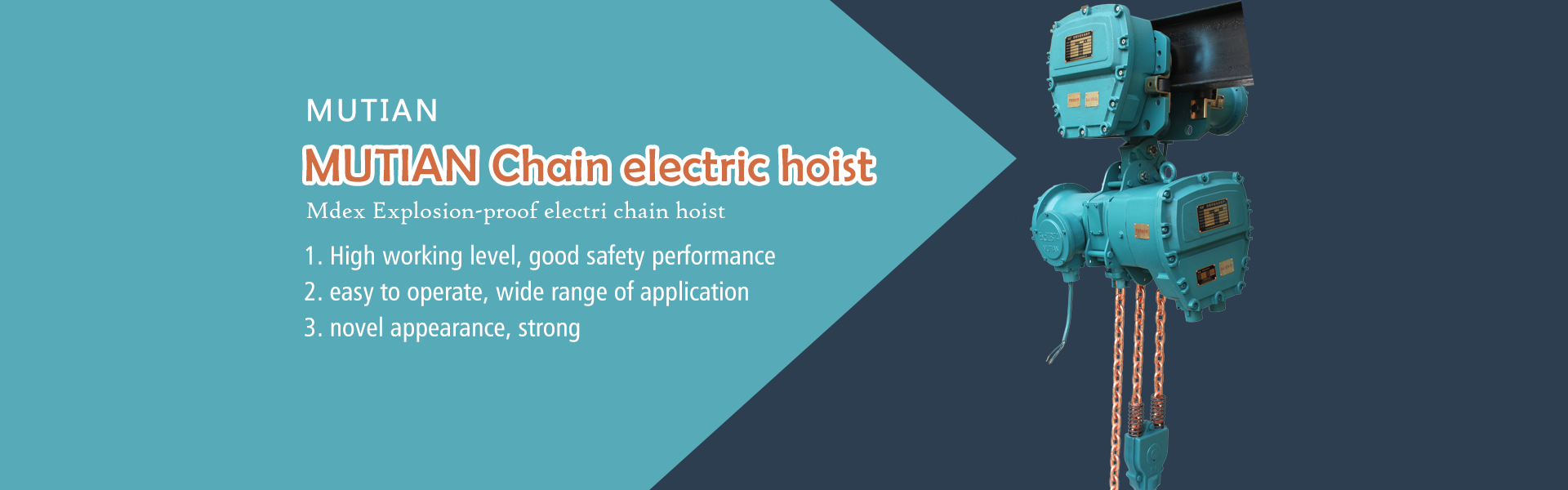
The explosion-proof hoist for mining needs to be equipped with an Ex dIIB T4 grade shell, and a gas recognition sensor should be installed at the air inlet. The use of flammable gases such as acetylene and hydrogen is prohibited.
5、 Personnel training and management
Operation qualification
All operators must undergo professional training, master equipment structure, safety regulations, and emergency response procedures, and pass the assessment before they can take up their posts.
protective equipment
During operation, it is necessary to wear a safety helmet, anti slip shoes, and canvas gloves (thicker thread gloves can be used as a substitute in the final assembly workshop). Welding processes require additional wrist guards and protective goggles.
Recording and Tracing
Establish equipment maintenance files to record information on each inspection, lubrication, and component replacement, achieving full lifecycle management.
6、 Compliance with regulations and standards
Strictly implement the "Practical Specification for Inspection and Scrapping of Steel Wire Rope for Lifting Machinery" (GB/T5972-1986), and scrap the load chain when the bending radius of the load chain is less than 3 times the chain diameter.
The limit switch is only used as an emergency braking device and is prohibited from being used for routine stopping operations.
It is prohibited to remove or blur warning signs on the device. If the safety slogan is missing, it must be immediately stopped.
The main equipment produced by Hebei Makita: stage electric hoist, electric chian hoist, wire rope electric hoist,Hand chain hoist, lever hoist, pneumatic hoist and other lifting equipment
 phone
phone
 service
 message
 e-mail
