 中文版
中文版





releaseTime:2025-10-24 08:16:43source:Mu TiannumberOfPageViews:0
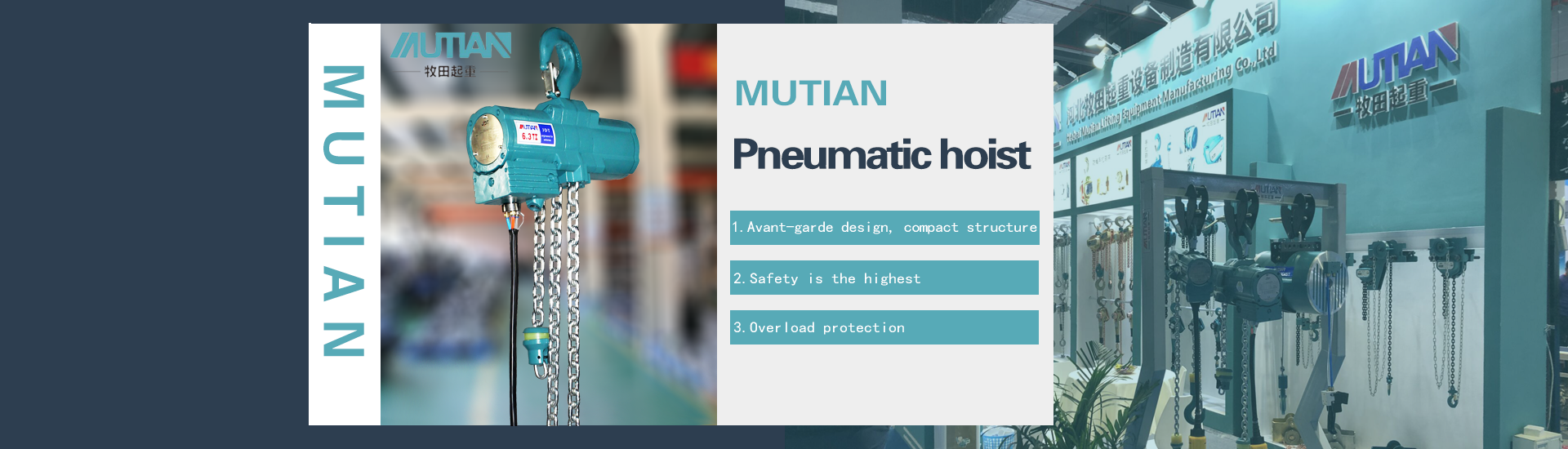
When operating a pneumatic hoist (pneumatic crane), it is necessary to ensure the safe and efficient operation of the equipment from the dimensions of equipment selection, safety devices, gas source and pipeline, operation specifications, maintenance, environmental adaptation, personnel qualifications, and compliance documents. The specific requirements are as follows:
1、 Equipment selection and adaptability
Load matching
Select the pneumatic hoist model based on the maximum load demand of the homework scenario, ensuring that the rated lifting capacity covers the actual working conditions and avoiding overloading operation. For example, automotive assembly lines need to choose models that support high-frequency and infinite speed changes, while the chemical industry needs to prioritize explosion-proof performance.
Structure type selection
Arm type: suitable for scenarios with limited space or requiring multi angle operation (such as mechanical processing workshops).
Soft rope type: suitable for long-distance vertical lifting (such as logistics and warehousing).
Fixed/Mobile: Choose according to the flexibility requirements of the work area, and the mobile type needs to be equipped with anti overturning devices.
Environmental adaptability
Explosion proof requirements: Explosion proof pneumatic hoists must be used in flammable and explosive places (such as chemical and paint workshops) and comply with national explosion-proof standards (such as Ex d Ⅱ CT4).
Corrosion resistance: Stainless steel material or surface anti-corrosion treatment equipment should be selected for high dust or corrosive environments.
Temperature range: High temperature resistant seals should be selected for high temperature environments, and preheating devices should be configured for low temperature environments.
2、 Safety devices and protection systems
overload protection
Mechanical or electronic overload limiters must be equipped to automatically cut off the power source when the load exceeds the rated value, preventing equipment damage or accidents.
braking system
Dual braking: The pneumatic brake is linked with the mechanical brake to ensure immediate braking in case of power failure or air supply interruption.
Braking test: Regularly conduct braking performance testing to ensure that the braking distance meets the standard (such as ≤ 0.5m/s ² deceleration).
limit stop
Install upper and lower limit switches to prevent the chain/wire rope from over winding or falling out of the groove, and to prevent equipment damage or heavy objects from falling.
Emergency stop
The operation panel and remote control device should be equipped with a red mushroom shaped emergency stop button, which immediately cuts off the air source and brakes when pressed.
3、 Requirements for gas source and pipeline
Gas source quality
Pressure range: The gas supply pressure should be stable at 0.5~0.7MPa, with a fluctuation range not exceeding ± 0.05MPa.
Cleanliness: Compressed air needs to undergo three-stage filtration (oil-water separator, precision filter, dryer), with an oil content of ≤ 5mg/m ³ and a particle size of ≤ 5 μ m.
Tubing Design
Material: Use high-pressure rubber hose or metal hose, with a compressive strength of ≥ 1.5 times the working pressure.
Layout: Avoid sharp turns or angles to reduce pressure loss; The fixed spacing of the pipeline is ≤ 1m to prevent vibration and wear.
Identification: The gas source pipeline should be marked with the direction of airflow and maximum working pressure, and color coded (such as red for high-pressure pipes).
4、 Operating standards and training
Operator Qualification
Operators need to undergo professional training and obtain a special equipment operator certificate, familiarize themselves with equipment structure, performance, and emergency response procedures.
operating procedure
Pre start inspection: Confirm that the air source connection, braking system, and limit device are functioning properly.
Load suspension: Use specialized lifting equipment to ensure the center of gravity is vertical and avoid side loading.
Operation monitoring: Continuously observe the load status during operation, and prohibit personnel from being under heavy objects.
Shutdown operation: After the heavy object falls to the ground, turn off the air source and release residual pressure.
Taboo behavior
Overloading, diagonal pulling, personnel carrying or dragging heavy objects with hooks are strictly prohibited.
Do not perform maintenance or adjustment without cutting off the gas source.
5、 Maintenance and Inspection
routine inspection
Before each shift, check the wear of the chain/wire rope, brake clearance, and air source connection sealing, and fill in the inspection record.
regular maintenance
Weekly inspection: Clean the surface of the equipment and lubricate moving parts (such as bearings and gears).
Monthly inspection: Check the braking performance, limit switch sensitivity, and replace worn parts.
Annual inspection: Comprehensive testing conducted by professional institutions, including non-destructive testing (such as magnetic particle testing of chains) and calibration of safety accessories.
Spare Parts Management
Reserve key spare parts (such as brake pads and sealing rings) to ensure a stock level of ≥ 3 months of usage requirements, and spare parts must meet the original factory specifications.
6、 Environment and auxiliary facilities
workspace
The operating area should be kept clean and free of obstacles; Ground bearing capacity ≥ 1.5 times the total weight (including load) of the equipment.
Lighting and ventilation
Lighting intensity ≥ 300lx, ensuring clear visibility during operation.
The ventilation system must meet explosion-proof requirements, with a ventilation rate of ≥ 6 times/h (in flammable and explosive areas).
firefighting facilities
Equipped with dry powder fire extinguishers or carbon dioxide fire extinguishers, with a spacing of ≤ 15m, and regularly checked for expiration dates.
7、 Compliance and Document Management
Equipment File
Establish equipment ledger, record model, factory number, installation date, maintenance history, and inspection report.
Operating Procedures
Develop written operating procedures and post them on the operating site, covering start-up, operation, shutdown, and emergency procedures.
Emergency Response Plan
Develop emergency plans for equipment failures, heavy object falls, and gas source leaks, and organize at least one drill per year.
The main equipment produced by Hebei Makita: stage electric hoist, electric chian hoist, wire rope electric hoist,Hand chain hoist, lever hoist, pneumatic hoist and other lifting equipment
 phone
phone
 service
 message
 e-mail
