 中文版
中文版




releaseTime:2025-10-23 09:08:50source:Mu TiannumberOfPageViews:0
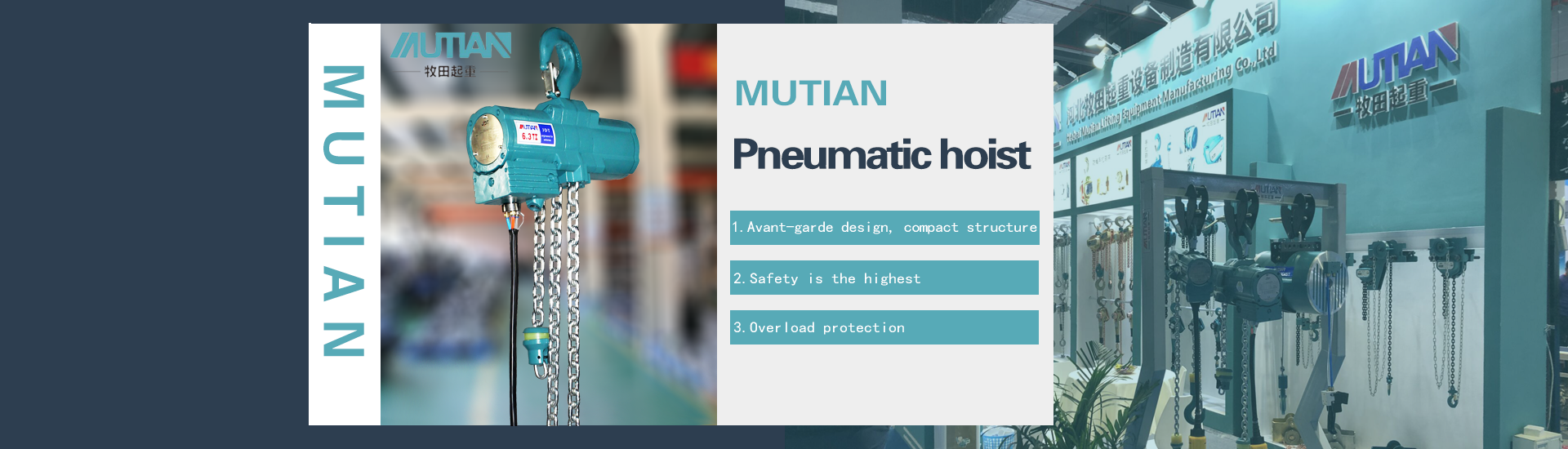
The trajectory requirements for operating pneumatic hoists need to revolve around four core aspects: installation stability, trajectory space planning, obstacle avoidance, and load balancing control to ensure safe and efficient operation of the equipment. The specific requirements are as follows:
1、 Installation stability requirements
Fixed installation: When using a fixed installation method for pneumatic hoists, it is necessary to ensure that the installation ground is flat, solid, and able to withstand the total weight of the hoist and its load. The installation location should be convenient for operators to observe the load status, while avoiding interference with other equipment or structures.
Cantilever crane configuration: If a pneumatic hoist is used in conjunction with a cantilever crane, the cantilever structure must have sufficient strength and stiffness to withstand the bending moment and torque generated by the hoist and load during rotation. The length of the cantilever should be determined according to the requirements of the work scope, while considering the spatial limitations within the rotation radius.
Guide rail movement configuration: When using the guide rail movement method, the guide rail needs to be horizontal and have high straightness to ensure that the hoist moves smoothly along the guide rail. The connection of the guide rail should have a smooth transition to avoid jamming or jumping when the hoist moves.
2、 Requirements for trajectory space planning
Rotation radius reservation: Under the cantilever crane configuration, sufficient rotation radius space needs to be reserved according to the cantilever length and hoist model. There should be no fixed obstacles within the rotation radius, such as columns, walls, etc., to ensure that the gourd can rotate freely 360 °.
Rail movement range: Under the rail movement configuration, it is necessary to clarify the movement range of the hoist and set limit devices at both ends of the rail to prevent the hoist from derailing. At the same time, there must be no dynamic obstacles on the guide rail movement path, such as moving vehicles, personnel, etc.
Division of homework area: According to the homework requirements, the homework area is divided into lifting area, moving area, and storage area. The lifting area should ensure that the hoist can lift the load vertically; Adequate space should be reserved in the mobile area for the gourd to move horizontally; The storage area should be convenient for temporary storage and transportation of loads.
3、 Obstacle avoidance requirements
Static obstacles: On the trajectory of the gourd, static obstacles such as pipelines, cable trays, etc. need to be identified and marked in advance. By adjusting the installation position or trajectory planning, ensure that the hoist does not collide with static obstacles during operation.
Dynamic obstacles: For dynamic obstacles in the work area, such as moving vehicles, personnel, etc., warning signs and safety distances need to be set up. At the same time, operators need to remain highly vigilant, closely observe the surrounding environment during the operation of the gourd, and promptly avoid dynamic obstacles.
Load swing control: During the process of lifting and moving loads, it is necessary to control the swing amplitude of the load to prevent collision with surrounding obstacles. This can be achieved by adjusting the lifting speed, using anti sway devices, or manually controlling by operators.
4、 Load balancing control requirements
Lifting posture: When lifting a load, it is necessary to ensure that the load is in a balanced state to avoid uneven force on the hoist due to the tilting of the load. It can be achieved by adjusting the position of the hook, using a balancing device, or manually aligning by the operator.
Horizontal movement balance: During the horizontal movement of a load, it is necessary to maintain the stability of the load and avoid shaking due to speed changes or uneven trajectories. It can be achieved through controlling the movement speed, using shock absorbers, or slow operation by the operator.
Multi load collaboration: If multiple loads need to be lifted and moved simultaneously, it is necessary to ensure balance and coordination between each load. This can be achieved through the use of synchronization devices, adjusting the lifting height of each load, or unified command by operators.
The main equipment produced by Hebei Makita: stage electric hoist, electric chian hoist, wire rope electric hoist,Hand chain hoist, lever hoist, pneumatic hoist and other lifting equipment
 phone
phone
 service
 message
 e-mail
