 中文版
中文版





releaseTime:2025-07-14 09:34:19source:Mu TiannumberOfPageViews:0
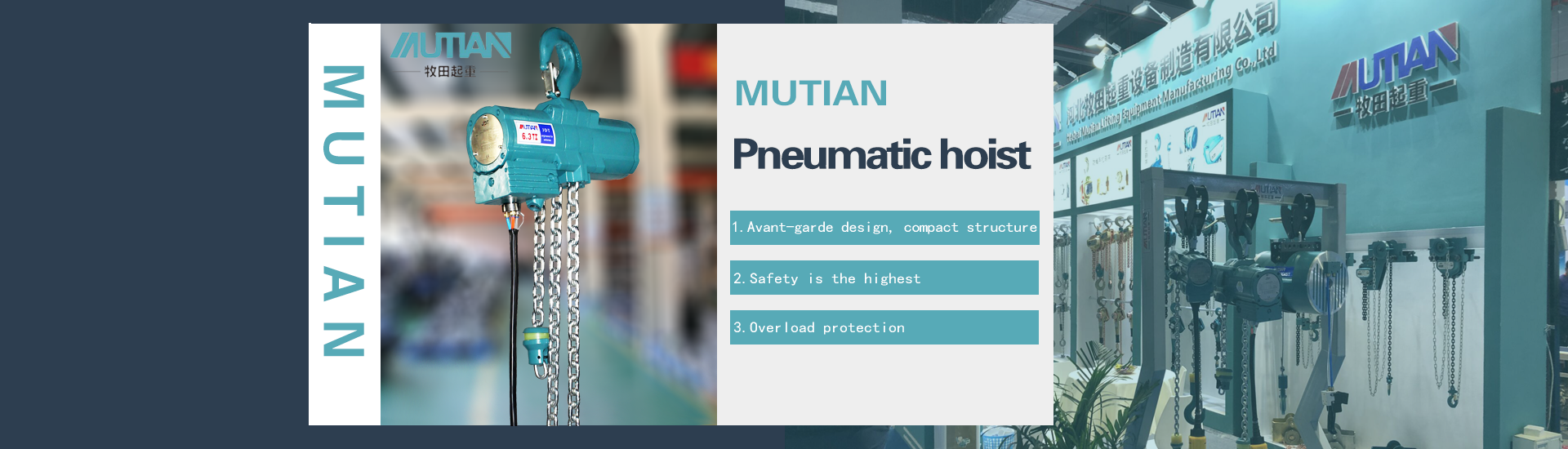
Explosion proof pneumatic hoists have become ideal lifting equipment in harsh environments such as flammability, explosiveness, high temperature, and high dust due to their excellent explosion-proof performance, flexible operating ability, and wide range of application scenarios. The following analysis will be conducted from three dimensions: performance advantages, application scenarios, and industry adaptability:
1、 Performance advantage: Dual guarantee of explosion-proof and flexibility
Inherent explosion-proof design
Pneumatic hoists use compressed air as their power source, completely avoiding the risk of explosion caused by electric sparks or high temperatures in electric hoists. The shell is made of aluminum alloy or explosion-proof alloy material, and the sealing structure strictly complies with explosion-proof standards (such as Ex d IICT4), ensuring safe operation in flammable and explosive places such as petroleum, chemical, and coal mines. For example, in the solvent filling line of a chemical plant, pneumatic hoists can stably lift flammable liquid containers without worrying about static electricity or spark hazards.
Infinite variable speed and precise positioning
The pneumatic motor supports stepless speed regulation, with a speed increase of up to 20-28m/min (three times that of an electric hoist), and a positioning accuracy of centimeter level. This characteristic is particularly important in fields such as automotive manufacturing and precision machining. For example, on the engine assembly line, the pneumatic hoist can gently lift the engine cylinder block to avoid collision damage, while achieving precise docking through fine-tuning functions.
Multiple security protection mechanisms
Gas cut protection: In the event of a sudden gas cut, the brake immediately locks to prevent the workpiece from falling.
Overload protection: When the load exceeds the rated value, the pneumatic motor automatically slows down or stops to avoid equipment damage.
Emergency braking: Equipped with a manual emergency stop button, it can instantly cut off the gas source to respond to unexpected situations.
Strong environmental adaptability
Pneumatic hoists do not require electricity and can work stably in humid, high temperature (up to 60 ℃), and high dust environments (such as textile factories and flour mills). The internal lubrication system uses explosion-proof grease to reduce the risk of friction sparks and extend the service life of the equipment.
2、 Application scenario: Covering high-risk and high-precision fields
Flammable and explosive places
Petrochemical industry: used for oil tank lifting, pipeline maintenance, reactor cover opening and other operations.
Coal mine: Lift equipment and support materials in underground tunnels to avoid the risk of gas explosions.
Spray painting workshop: Lift painted workpieces to prevent electrical sparks from igniting solvent vapors.
High temperature and high dust environment
Steel smelting: Lifting steel ladles next to the steelmaking furnace to withstand high temperature radiation.
Cement plant: Lift bagged cement in a dusty raw material warehouse to reduce equipment failure rate.
Continuous operation production line
Automobile manufacturing: Lifting heavy objects such as vehicle bodies and engines in assembly lines and welding lines, supporting 24-hour continuous operation.
Logistics warehousing: Cooperate with track movement in automated three-dimensional warehouses to achieve rapid transportation of goods.
Special workpiece lifting
Glass factory: Lift fragile glass panels and achieve light handling through stepless variable speed.
Aerospace: Lifting precision aviation components to avoid deformation caused by mechanical impact.
3、 Industry adaptability: comprehensive penetration from traditional industries to emerging fields
Traditional industrial sector
Chemical and Textile: Pneumatic hoists have become standard equipment in the industry, especially in solvent storage areas and dye workshops with strict explosion-proof requirements.
Dock and Storage: Replace electric hoists in container lifting and cargo loading and unloading to reduce fire risks.
Emerging manufacturing fields
New energy vehicles: Lift battery cells and modules in the battery production line to avoid short circuits caused by static electricity.
Semiconductor manufacturing: Lift the wafer box in the clean room with an oil-free lubrication system to prevent contamination of sensitive components.
International market trends
In industrialized countries such as Germany and the United States, pneumatic hoists have been included in mandatory usage standards. For example, OSHA regulations in the United States require the use of pneumatic or hydraulic power equipment in Class I Division 1 hazardous areas. This trend has driven continuous innovation in pneumatic hoist technology, such as the lightweight design of blade type pneumatic motors and the integration of intelligent control systems.
4、 Typical case: Practical performance of pneumatic hoist
Maintenance of a chemical plant reactor:
Traditional electric hoists were eliminated due to insufficient explosion-proof rating. After switching to pneumatic hoists, maintenance efficiency increased by 40% and no safety accidents occurred.
Automotive assembly line upgrade:
After a certain car company replaced electric hoists with pneumatic hoists, the engine assembly time was reduced by 25%, the failure rate decreased by 60%, and the labor intensity of workers was also reduced.
The main equipment produced by Hebei Makita: stage electric hoist, electric chian hoist, wire rope electric hoist,Hand chain hoist, lever hoist, pneumatic hoist and other lifting equipment
 phone
phone
 service
 message
 e-mail
