 中文版
中文版





releaseTime:2025-07-15 09:09:47source:Mu TiannumberOfPageViews:0
To ensure the safe operation of explosion-proof pneumatic cranes, a safety system needs to be constructed from five dimensions: equipment inspection, operating standards, environmental management, personnel training, and emergency response. Specific measures are as follows:
1、 Comprehensive inspection before operation: eliminate equipment hazards
Special inspection of explosion-proof performance
Confirm the sealing of explosion-proof electrical equipment, check whether the introduction device adopts cable sealing ring type, and only allow one rubber sheathed round cable to be introduced at each location to avoid sparks caused by loose or damaged cables.
Check the explosion-proof structure of mechanical components, such as whether the hook is equipped with anti impact spark measures (such as copper or copper plated hooks for Class IIC explosion-proof cranes), to ensure that there are no cracks or mechanical deformations on the surface.
To verify the reliability of the braking system, the lifting mechanism needs to be equipped with two sets of explosion-proof brakes, and the surface temperature of the brakes must not exceed the specified value (such as polyurethane buffer surface resistance ≤ 100 Ω).
Functional testing of pneumatic system
Check if the air source pipeline is clean, filter impurities through the pneumatic three-way combination (water separator, pressure regulating valve, oil mist device), and adjust the air pressure to 0.4-0.6MPa to ensure that the oil dripping speed is controlled at 25-30 drops/minute to lubricate the pneumatic components.
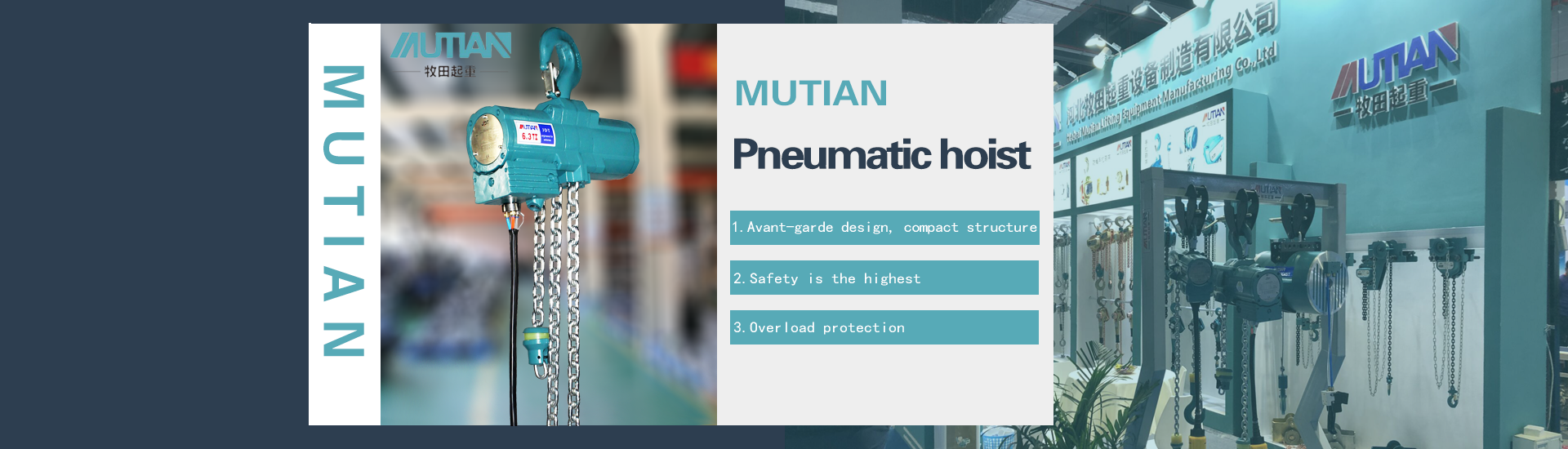
No load operation test: Operate the pneumatic hoist to repeatedly lift and lower 3-4 times, check whether the chain runs smoothly and whether the brakes are sensitive; The traction walking mechanism needs to test the hill start stop function to ensure that the uphill assist and steep slope descent device are functioning properly.
Environmental adaptability assessment
Remove flammable and explosive materials from the work area, use professional equipment to detect the concentration of explosive mixtures in the environment, ensure good ventilation and a temperature below the maximum allowable value of the equipment (such as explosion-proof cranes with a working level not exceeding A5 and environmental temperature controlled within the specified range).
Check the connection status of the track, and ensure that the welded joints are smooth and not misaligned. The lateral displacement and height difference of the track should be ≤ 0.5mm to avoid sparks caused by equipment shaking due to track defects.
2、 Standardized execution during operation: control risk behavior
Load and speed limitations
Strictly follow the load slope table and prohibit overloading operation (such as DQD30 pneumatic monorail crane with a rated lifting capacity of 14t, maximum operating speed of 20m/min, and maximum suitable slope of 20 °).
Control the lifting speed to ≤ 8m/min and the wire rope winding speed to ≤ 28m/min to avoid load swing or wire rope breakage caused by excessive speed.
Multi action collaborative taboo
Simultaneous operation of lifting and walking is prohibited. The lifting or lowering action must be completed to a stable state before starting the walking mechanism to prevent the load from losing control due to inertia.
When two people work together, the driver only follows the signals of the designated commander before lifting, but must immediately respond to any dangerous stop signals (such as gestures, whistles).
Special working condition response strategy
When working on a slope, the operator should be located above the direction of the monorail crane and adjust the operating angle using remote control or manual control valves to avoid equipment loss of control due to gravity acceleration.
When the brake of the lifting mechanism fails, immediately push the controller handle to the fully lowered position, and operate the crane and trolley to find a safe area to prevent heavy objects from falling and causing secondary accidents.
3、 Environmental Dynamic Monitoring: Preventing External Risks
Real time monitoring of environmental parameters
Use explosion-proof gas detectors to continuously monitor the concentration of combustible gases in the work area. When the concentration approaches 25% of the lower explosive limit, immediately stop the work and evacuate personnel.
Check the surface temperature of the equipment, especially electrical components such as motors and switches, to ensure that the temperature does not exceed the specified value (for example, the surface temperature of explosion-proof motors should be lower than 135 ℃ in T4 group).
Isolate hazardous areas
Set up warning signs within the operating range of the crane and prohibit non operating personnel from entering; When using lifting electromagnets, a designated work area must be designated, and personnel are strictly prohibited from staying in the area to prevent heavy objects from falling.
Clean up obstacles on both sides of the track to ensure that the walking mechanism has no collision risk when turning or climbing, and to avoid sparks caused by friction.
4、 Personnel Qualification and Training: Strengthening Safety Awareness
Qualification requirements for operators
Drivers need to undergo professional training and obtain an explosion-proof crane operation certificate, familiar with equipment explosion-proof performance, operating procedures, and emergency response measures.
Maintenance personnel must have explosion-proof electrical maintenance qualifications, and it is strictly prohibited to replace or modify explosion-proof components without authorization (such as changing the gap between explosion-proof surfaces or using non explosion-proof signal devices).
Regular safety drills
Organize an emergency drill for explosion-proof crane accidents every quarter, simulating scenarios such as brake failure and gas leakage, and training operators in rapid response capabilities.
Carry out explosion-proof knowledge training, focusing on explaining the generation mechanism and preventive measures of electrical sparks and mechanical friction sparks, and strengthening the ability to identify risks.
5、 Emergency response mechanism: reduce accident losses
Develop emergency plans
Develop special contingency plans for scenarios such as gas leaks and electrical fires, and clarify emergency response procedures (such as cutting off gas sources, using explosion-proof tools to extinguish fires, evacuation routes, etc.).
Equipped with explosion-proof emergency equipment, such as explosion-proof walkie talkies, explosion-proof flashlights, dry powder fire extinguishers, etc., to ensure safe use in hazardous environments.
Post accident handling process
Immediately stop the machine and cut off the gas source after an accident occurs, protect the scene, and report to the safety management department.
Professional personnel shall inspect the equipment for damage, and after repair, it must pass explosion-proof performance testing before being put back into use. It is strictly prohibited to operate with defects.
The main equipment produced by Hebei Makita: stage electric hoist, electric chian hoist, wire rope electric hoist,Hand chain hoist, lever hoist, pneumatic hoist and other lifting equipment
 phone
phone
 service
 message
 e-mail
