 中文版
中文版




releaseTime:2025-10-17 08:55:09source:Mu TiannumberOfPageViews:0
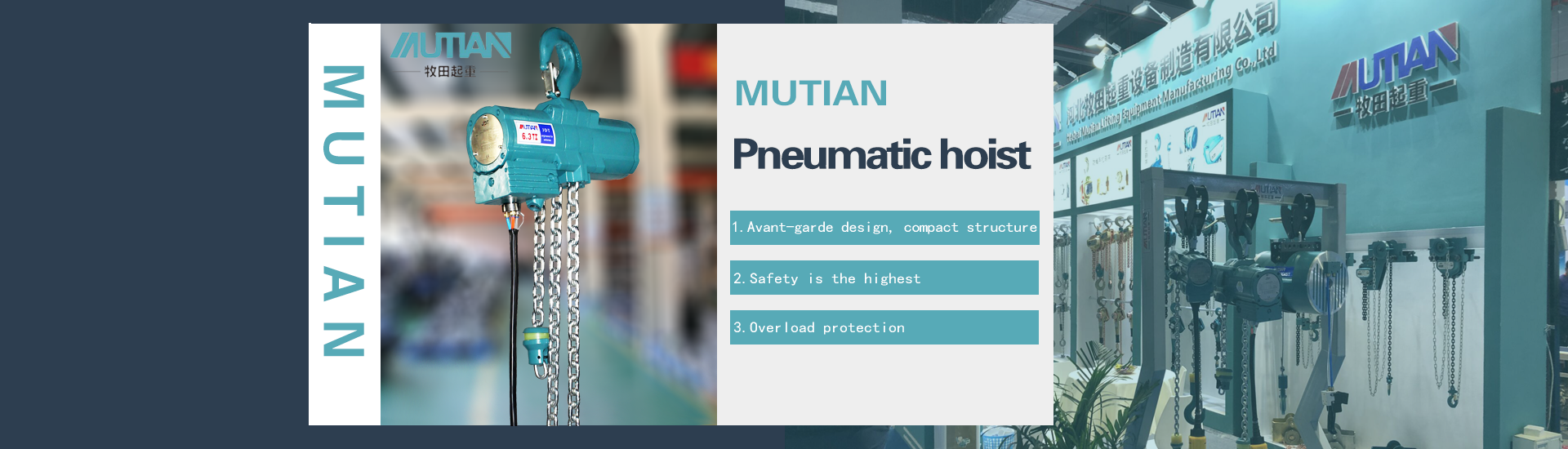
When evaluating the quality of pneumatic hoists during operation, analysis should be conducted from four core dimensions: material and process, safety devices, operational performance, and maintenance services. Specific indicators and evaluation points are as follows:
1、 Material and craftsmanship: the foundation of load-bearing capacity and durability
Quality of key components
Hook and chain: High strength alloy steel (such as 40Cr, 20Mn2) should be selected, quenched and tempered to ensure a tensile strength of ≥ 800MPa. Poor quality materials can easily lead to breakage and cause safety accidents.
Shell and gear: Made of aluminum alloy or ductile iron, lightweight while ensuring structural strength. Korean brands such as KHC use precision casting technology to reduce internal defects and extend service life.
Manufacturing process standards
Comply with GB/T 3173-2003 "Crane Machinery - Wire Rope Hand Pulley" or JB/T11963-2014 "Pneumatic Hoist", ensuring machining accuracy (such as gear mesh clearance ≤ 0.2mm).
Poor quality craftsmanship may lead to loose fitting of components, causing operational shaking or abnormal noise.
2、 Safety device: the core guarantee for risk prevention and control
Essential security features
Overload protection: Real time monitoring of load through pressure sensors, automatic shutdown when exceeding the rated value (such as a hoist with a rated load of 10t, triggering protection when overloaded by 10%).
Cut off gas protection: When the gas source is interrupted, the brake instantly locks to prevent heavy objects from falling (test method: cut off the gas source under load, observe the braking distance ≤ 5mm).
Limit switch: The upper and lower limit error is ≤± 10mm to avoid the chain/wire rope from over winding or slipping out of the groove.
Certification and Standards
Priority should be given to products that have passed CE certification and ISO 9001 quality management system certification to ensure compliance with international safety standards.
Products lacking certification may have hidden dangers such as brake failure and limit failure.
3、 Operational performance: a direct reflection of efficiency and stability
Improve speed and speed range
Stepless speed regulation: The pneumatic hoist can achieve smooth speed regulation of 0-17m/min by controlling the pressure of the handle, which is suitable for precision assembly (such as car engine lifting).
Speed comparison: The operating speed of pneumatic hoists is 3 times that of electric hoists and 5-10 times that of manual hoists, significantly improving work efficiency.
Stability of operation
Noise control: High quality products operate with a noise level of ≤ 75dB (A), while inferior products may produce harsh and abnormal sounds due to gear wear or air leakage.
Shake test: During no-load operation, the hoist should not have obvious lateral or longitudinal shaking, otherwise it may be caused by insufficient chain tension or excessive gear clearance.
4、 Maintenance service: the key to long-term usage costs
Supply of vulnerable parts
Key components such as seals, bearings, and sprockets should be provided with original factory accessories, and the replacement cycle should be clear (e.g. seals are recommended to be replaced every 2000 hours).
Products lacking accessory support may result in extended downtime for repairs and increased hidden costs.
After sales service response
High quality brands (such as Korean KHC) offer a one-year warranty and respond to repair needs within 48 hours.
Products with missing after-sales service may be scrapped due to minor malfunctions, increasing replacement costs.
5、 Typical manifestations and risks of quality defects
Material defects
Phenomenon: Hook breakage, chain elongation exceeding the standard (>5%).
Risk: Heavy objects falling, causing personal injury or equipment damage.
Safety device failure
Phenomenon: Overloading without alarm, brake failure after gas interruption.
Risk: Use in flammable and explosive places (such as chemical workshops) may cause explosion accidents.
operational failure
Phenomenon: Air leakage, motor stall, and inflexibility in ascending and descending.
Risk: Interruption of homework, affecting production progress.
6、 Evaluation Conclusion and Selection Suggestions
High quality product features
Material: High strength alloy steel+precision casting process.
Safety: Overload protection, gas cut-off protection, and complete limit switches.
Performance: Stepless speed regulation, low noise, smooth operation.
Service: Original factory parts supply, fast after-sales response.
Risk of inferior products
Poor material quality leads to breakage, lack of safety devices causes accidents, and frequent operational failures increase downtime costs.
Purchase Recommendations
Priority should be given to brands that have passed CE/ISO certification, such as Korean KHC and Japanese NPK.
Require suppliers to provide material testing reports and safety device testing videos.
Clearly define the warranty period and accessory supply terms before signing the contract to avoid disputes in the future.
The main equipment produced by Hebei Makita: stage electric hoist, electric chian hoist, wire rope electric hoist,Hand chain hoist, lever hoist, pneumatic hoist and other lifting equipment
 phone
phone
 service
 message
 e-mail
