 中文版
中文版





releaseTime:2025-10-25 08:40:45source:Mu TiannumberOfPageViews:0
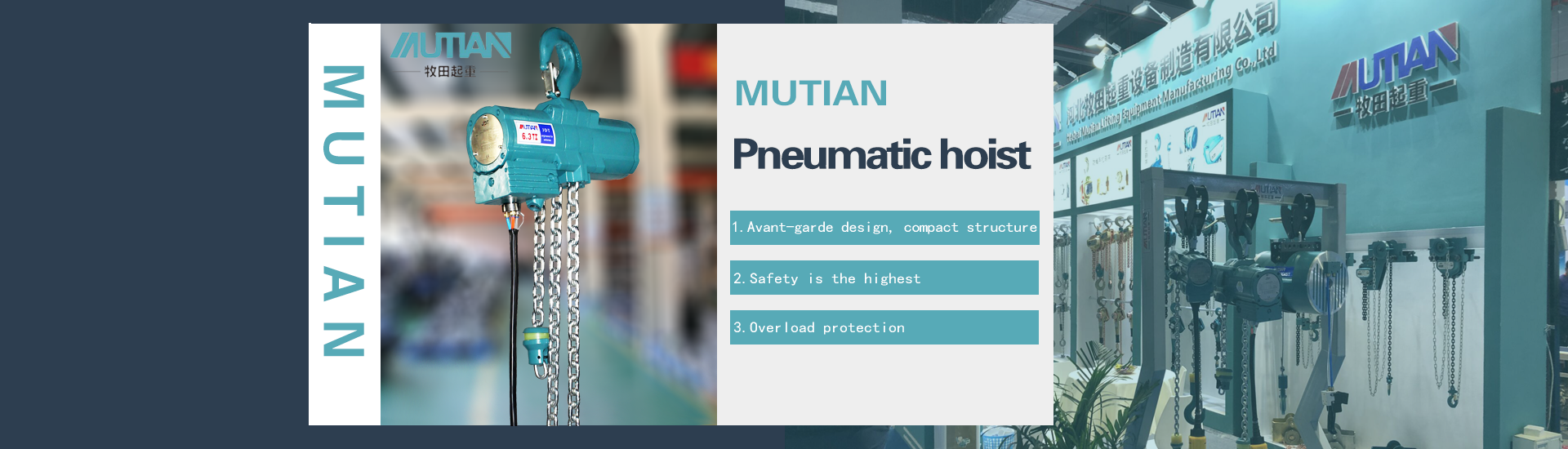
The operation of the pneumatic balance hoist (pneumatic hoist) during operation must follow standardized procedures, covering five core links: equipment inspection, load fixation, air pressure regulation, action control, and safety regulations. The specific steps are as follows:
1、 Pre operation inspection: Ensure the safety of equipment and working environment
Air source system inspection
Confirm that the compressed air pressure is within the range of 0.4-0.6MPa and monitor it in real-time through a pressure gauge.
Check whether the tracheal connection is firm, without aging, cracks or air leakage, and focus on inspecting the joints, filters and lubrication devices.
Clean the dust inside the trachea to prevent impurities from entering the pneumatic system and causing valve body blockage or wear.
Inspection of lifting equipment and load
Check if the hooks and fixtures are intact, without cracks, deformations, or wear, and ensure that the locking mechanism is functioning properly.
Choose appropriate lifting equipment based on the weight and shape of the load. For heavy loads, use multi-point fixing or specialized fixtures. For irregular loads, adjust the center of gravity balance.
Control system inspection
Test the sensitivity of the handle and buttons to ensure rapid and unobstructed response to movements such as up/down and rotation.
Check the braking system and test its braking performance under no-load conditions to ensure that the load can stably stop at any position.
2、 Load fixation: safety suspension and balance adjustment
Load suspension
Fix the load steadily on the lifting device to avoid tilting or shaking. If the load is heavy or the shape is complex, multi-point fixation or specialized fixtures should be used to ensure that the center of gravity is centered.
Check if the hook lock is securely fastened to prevent the load from falling off.
Air pressure balance regulation
Activate the air source switch to put the pneumatic motor in standby mode and keep the lifting device stationary.
Gradually adjust the balance valve according to the weight of the load, so that the lifting device can easily move and maintain balance when suspended. During the adjustment process, it is necessary to operate slowly to avoid load shaking caused by sudden changes in air pressure.
3、 Action control: precise operation and speed adjustment
Upward operation
Press the handle or button to control the pneumatic motor to start, and the lifting device begins to rise.
Maintain even pressure on the handle to ensure smooth lifting of the lifting device. If the load is heavy, the air pressure can be increased appropriately, but sudden acceleration should be avoided.
Lowering operation
Release the handle or button, the pneumatic motor stops working, and the lifting device slowly descends under the weight of the load.
By adjusting the balance valve to control the descent speed, ensure that the load lands smoothly. During the descent process, it is necessary to closely observe the load status to prevent collisions.
Rotating operation (if equipped)
Control the rotation of the lifting device through a handle or button, and rotate slowly to avoid the load shaking or colliding with surrounding equipment due to excessive inertia.
Maintain clear visibility during rotation and ensure that there are no obstacles in the rotation path.
4、 Safety regulations: Protection of operators and equipment
personnel protection
Operators are required to wear safety helmets, gloves, protective goggles, and other equipment to prevent accidental injuries.
Operators are prohibited from standing under the load or on the lifting path to ensure a safe distance.
Load limit
Strictly adhere to the rated load of the equipment and prohibit overloading. Overloading may cause equipment damage or safety accidents.
Avoid inclined lifting, pulling lifting, or rapid lifting to prevent load shaking or equipment imbalance.
Environmental Management
Keep the operating area clean and free from debris accumulation to prevent any impact on equipment operation or safety.
When used in humid, high-temperature, or corrosive environments, it is necessary to strengthen equipment protection, such as installing protective covers or regularly cleaning.
emergency response
If any equipment abnormalities are found during operation (such as air leakage, loose lifting equipment, abnormal noise, etc.), the operation should be stopped immediately, the gas source switch should be turned off, and maintenance personnel should be notified for handling.
If there is a loss of control of the load or equipment failure, the operator should quickly evacuate the dangerous area to avoid injury.
5、 Post operation maintenance: equipment maintenance and status recording
Equipment cleaning
After the operation is completed, place the load in a safe position and turn off the gas source switch.
Clean the dust and debris on the surface of the equipment to keep it clean.
Component inspection
Regularly inspect the wear and tear of key components such as pneumatic motors, balance valves, and air pipes, and replace aging or damaged components in a timely manner.
Check the integrity of the lifting equipment and hooks to ensure there are no cracks or deformations.
Lubrication and maintenance
Regularly apply lubricating grease to moving parts such as cylinders and piston rods to reduce friction losses.
Add lubricating oil to components such as pulleys and bearings to ensure smooth operation.
Record and feedback
Record the operating status, maintenance status, and abnormal events of the equipment to provide reference for subsequent operations.
Regularly provide feedback on equipment usage to the equipment management department and promptly resolve potential issues.
The main equipment produced by Hebei Makita: stage electric hoist, electric chian hoist, wire rope electric hoist,Hand chain hoist, lever hoist, pneumatic hoist and other lifting equipment
 phone
phone
 service
 message
 e-mail
