 中文版
中文版





releaseTime:2025-10-22 09:20:20source:Mu TiannumberOfPageViews:0
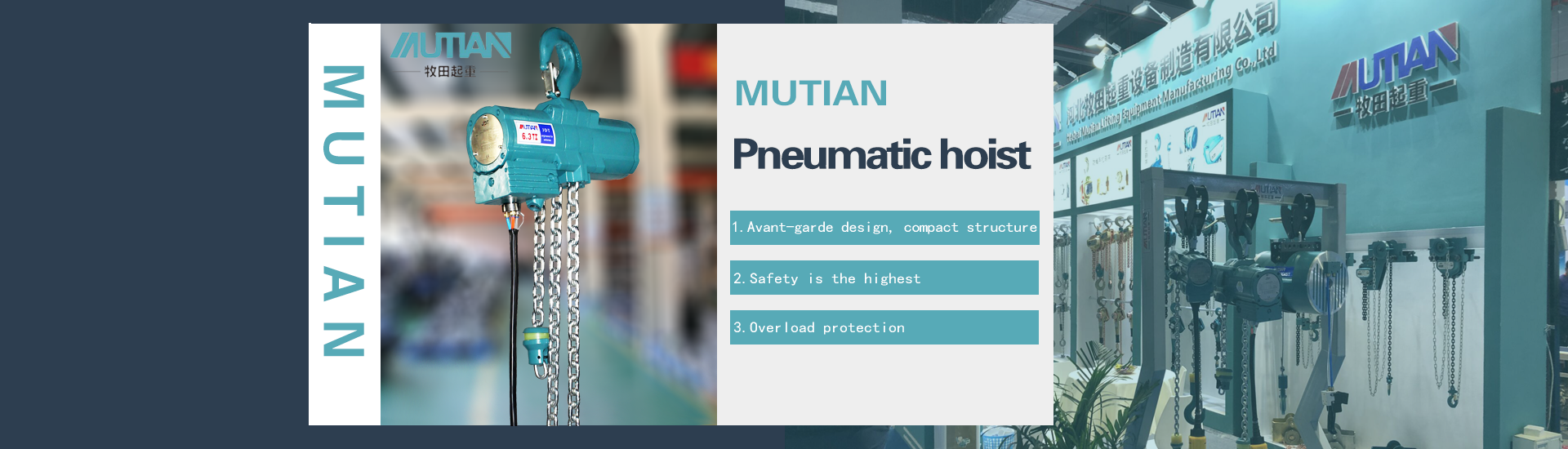
A pneumatic hoist in operation is an explosion-proof lifting equipment powered by compressed air. Its core is to drive the mechanical transmission system through a pneumatic motor to achieve precise lifting, traction, and loading/unloading of heavy objects. The following analysis is conducted from five dimensions: device composition, working principle, operation mode, performance advantages, and safety regulations:
1、 Equipment composition
The pneumatic hoist consists of four core systems:
Air distribution system: Using compressed air (usually 0.4-0.6MPa) as the power source, the direction of airflow is adjusted through control valves to achieve the lifting, lowering, and stopping of the hoist.
Power system: It is driven by pneumatic motors (blade type, piston type, or cylinder type) without the need for power supply, avoiding the risk of electrical sparks.
Deceleration system: By using planetary reducers or gear sets to reduce speed and increase torque, it ensures smooth lifting of heavy objects.
Winch system: composed of chains or wire ropes, connected to hooks to achieve lifting and lowering of heavy objects.
2、 Working principle
Power transmission: Compressed air enters the pneumatic motor, drives the motor to rotate, and transmits power to the hoisting system through the deceleration system.
Heavy lifting: The hoisting system retracts the chain/wire rope to drive the hook and heavy object up or down.
Precise control: By operating control valves (such as handles, buttons, or ropes) to adjust the size of the airflow, stepless speed regulation and centimeter level positioning can be achieved.
3、 Operation method
Start and Stop:
Press the "UP" lever to raise the hook; Press the 'DOWN' lever to lower the hook.
Release the lever and the hook stops moving.
Speed regulation:
The depth of lever pressing determines the lifting speed, and the deeper the pressing, the faster the speed.
Load limit:
The load-bearing range of different models is 250 kilograms to 30 tons, and the appropriate load should be selected according to the equipment specifications.
4、 Performance advantages
Explosion proof safety:
Suitable for flammable and explosive environments such as petroleum, chemical, and coal mines, to avoid accidents caused by electrical sparks.
Efficient and energy-saving:
The operating speed can reach three times that of an electric hoist, supporting high-frequency continuous operation.
Accurate positioning:
Micro motion function achieves millimeter level positioning, meeting the requirements of precision assembly.
Strong environmental adaptability:
Can operate under harsh conditions such as humidity, high dust, and high temperature (-20 ℃ to+70 ℃).
Low maintenance cost:
High precision machining of components, long lifespan, and low failure rate.
5、 Safety regulations
Pre operation inspection:
Check if the chain/wire rope anchoring connection is secure and if the brake adjustment is correct.
Confirm that the gas source pressure is within the recommended range (such as 90 PSI) and avoid being too high or too low.
Precautions during operation:
Maintain a stable standing posture and avoid operating on inclined or unstable surfaces.
Use hook locks to secure the load and prevent it from slipping.
Avoid overloading and strictly adhere to the equipment's load-bearing range.
Emergency situation handling:
Gas cut-off protection function: In case of sudden gas cut-off, the brake automatically locks to prevent the load from dropping.
Regularly check the effectiveness of safety devices such as overload protection and gas cut-off protection.
The main equipment produced by Hebei Makita: stage electric hoist, electric chian hoist, wire rope electric hoist,Hand chain hoist, lever hoist, pneumatic hoist and other lifting equipment
 phone
phone
 service
 message
 e-mail
