 中文版
中文版





releaseTime:2025-10-25 08:52:37source:Mu TiannumberOfPageViews:0
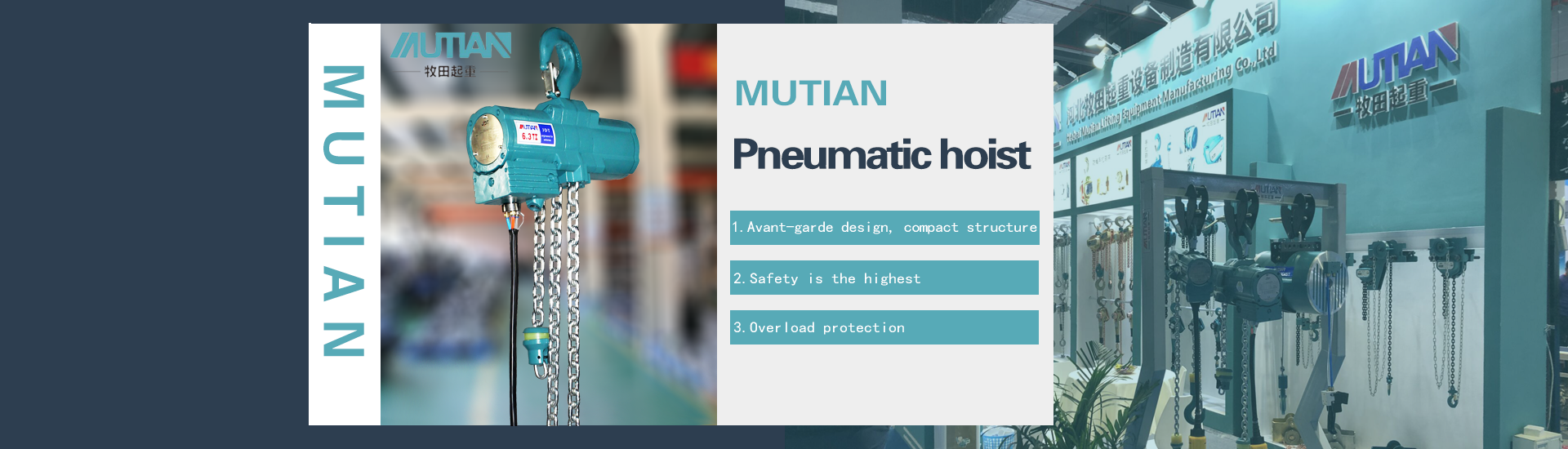
The internal structure of the pneumatic balance hoist (pneumatic hoist) in operation is complex and precise, mainly composed of five parts: the main engine structure, pneumatic system, transmission and braking device, safety and control mechanism, and suspension and auxiliary device. Each part works together to achieve efficient and safe material handling. Here is a specific introduction:
1、 Host structure
Balance cylinder: As the core power component of the pneumatic balance crane, the balance cylinder generates power through the linear reciprocating motion of the piston. Its internal design is precise, ensuring the smoothness and sealing of piston movement, thereby effectively transmitting power.
Screw mechanism: The screw mechanism converts the linear reciprocating motion of the piston in the balance cylinder into rotational motion. This conversion process is crucial for achieving the rotation of the wire rope drum, as it determines the smoothness of material lifting and lowering.
Wire rope drum: The wire rope drum rotates under the drive of the screw mechanism, and then lifts and lowers the object through the wire rope. The design of the drum needs to consider factors such as the winding method and friction coefficient of the steel wire rope to ensure the safety and efficiency of material handling.
2、 Pneumatic system
Pneumatic control system: The pneumatic control system is the key to achieving a weightless floating state for pneumatic balance cranes. It adjusts the pressure inside the cylinder through a precise pneumatic pressure reducing valve, ensuring that the load can remain balanced at any position. The accuracy of the pneumatic control system directly affects the positioning accuracy and movement speed of heavy objects.
Air source processing components: including filters, busbars, etc., used for purifying and distributing compressed air. Filters can remove impurities and moisture from the air, preventing damage to the pneumatic system; The manifold combines multiple gas sources into one, simplifying the layout of the gas path.
Directional valve and throttle valve: Directional valve is used to control the on/off and direction of airflow, achieving the rise and fall of materials; The throttle valve is used to regulate the size of the airflow and control the speed of material movement.
3、 Transmission and braking device
Transmission device: In pneumatic hoists, the transmission device usually includes pneumatic motors, planetary reducers, etc. The pneumatic motor converts the pressure energy of compressed air into mechanical energy, driving the planetary gearbox to operate; The planetary reducer transmits power to the lifting mechanism by reducing speed and increasing torque, achieving the retraction and extension of the chain or wire rope.
Brakes: Brakes are important components that ensure the safe operation of pneumatic balance cranes. It can achieve fast and accurate braking during the lifting and lowering process of materials, preventing materials from continuing to move or fall due to inertia. The performance of the brake directly affects the safety and stability of material handling.
4、 Safety and Control Organization
Safety mechanisms: including overspeed protection mechanisms, overload protection mechanisms, etc. The overspeed protection mechanism can automatically cut off the gas source when the material moves too fast, preventing accidents from occurring; The overload protection mechanism can automatically stop running when the load exceeds the rated value, protecting the safety of equipment and personnel.
Control signal system: The control signal system is the foundation for achieving automation and intelligent control of pneumatic balance cranes. It collects parameters such as load weight and displacement through sensors, converts these parameters into control signals, and transmits them to the pneumatic control system for adjustment. The accuracy and response speed of the control signal system directly affect the accuracy and efficiency of material handling.
5、 Suspension and auxiliary devices
Suspension device: The suspension device is used to support the entire equipment and is customized according to the requirements of the user's service area and on-site conditions. It usually includes components such as columns, cantilevers, folding arms, air pipes, tracks, etc., which can ensure the stable operation of equipment in complex environments.
Grasping fixture: A grasping fixture is a device that enables the grabbing of workpieces and completes the corresponding handling and assembly requirements of users. It is customized based on factors such as the shape, size, and weight of the material, ensuring the stability and safety of the material during transportation.
The main equipment produced by Hebei Makita: stage electric hoist, electric chian hoist, wire rope electric hoist,Hand chain hoist, lever hoist, pneumatic hoist and other lifting equipment
 phone
phone
 service
 message
 e-mail
